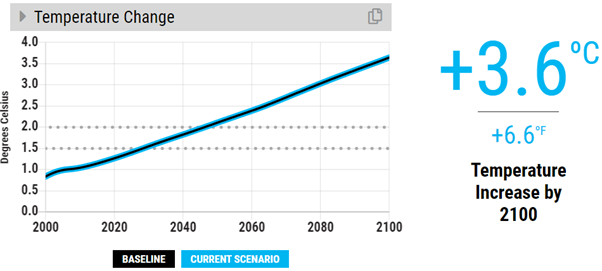
The Paris Climate Accords set a target of limiting global warming to below 2°C above pre-industrial levels, and preferably to below 1.5°C. Currently, the world is on a trajectory for warming of 3.6°C by 2100, with further warming beyond that date. At this rate, 1.5°C of warming will happen by 2030. We’re on an unsustainable path. All charts in this article are from Climate Interactive’s En-ROADS tool.
Technology has been touted as a solution to the problem of climate change, and many of technology’s biggest supporters even think that it is capable of solving the problem alone. At To the pound we’re certainly not closed to that idea; we’ve seen before how quickly new technological advancements can change the world, so we wouldn’t rule out a major new breakthrough that drastically re-writes the climate question.
But we’re also pragmatic observers of what is right in front of us. There’s more information in what we can observe now, than what we can imagine might be in the future. Based on sophisticated systems modelling, Climate Interactive’s En-ROADS tool (find it here) allows us to assess – knowing what we know now – how effective technology might be in tackling climate change. So, let’s look at some scenarios.
First, let’s extensively subsidise the use of carbon capture and storage (CCS) technology applied to existing coal-fired power plants. To be clear, this doesn’t reduce the use of coal, it just applies technology to reduce the impact of coal on global warming. How far does that get us? Not very…
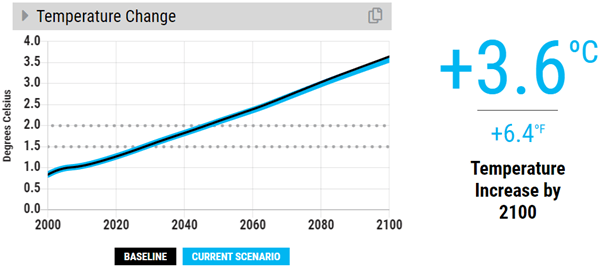
Ok, but that’s subsidising potentially very expensive technology. What if a technological breakthrough actually reduced the cost of carbon capture and storage at coal-fired plants?
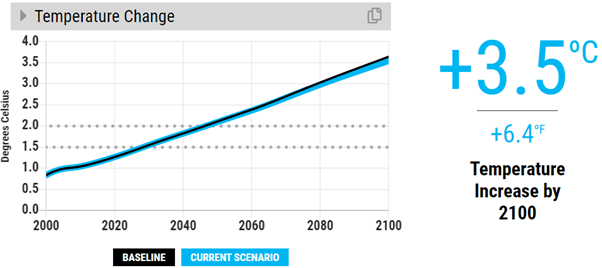
Getting there, but we don’t think any of you are writing home yet.
Why don’t we apply of this same technology, with the breakthrough cost-reductions, to natural gas-fired power plants too?
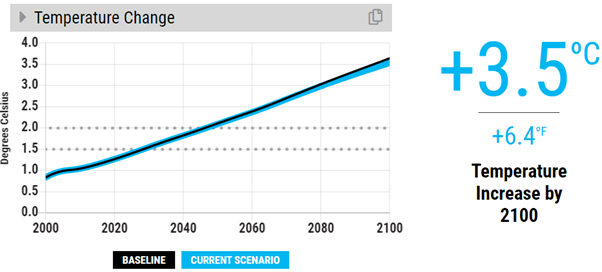
Erm, did the chart update? Maybe our computer is frozen… refresh refresh…
Are you thinking what we’re thinking? That maybe actually reducing the combustion of coal and natural gas to produce electricity, rather than just slapping a CCS facility on top of existing plants, might be a more powerful solution? Well, no-one cares. This article is about how technology can help solve the climate problem.
What about a technological breakthrough that reduces the cost of renewable energy?
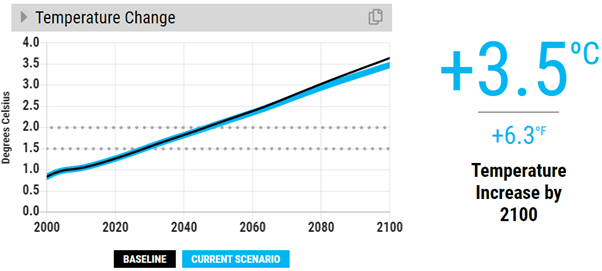
Nice. A 0.1° reduction in temperature. Now we’re talking. Oh, that was Fahrenheit by the way. What about a breakthrough in renewable energy storage technology? Storage is an efficiency issue that has plagued the rollout of renewable energy since inception. Because the sun doesn’t shine all day, the wind doesn’t blow consistently, and water can’t defy gravity (actually, new tech is attempting to do this), traditional sources of energy and required to plug in the gaps and fill the demand. Breakthroughs in storage tech would be a huge boon for the renewables rollout
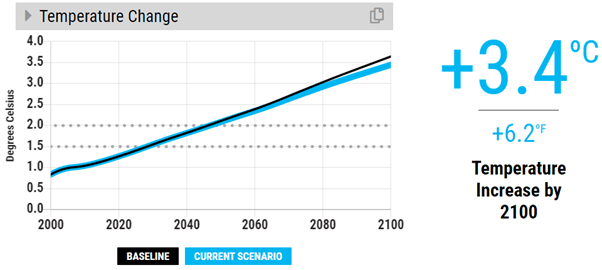
We won’t be quite as sarcastic with this one. It does help reduce temperatures in the long run, and we also think it could reduce friction and indecision where infrastructure planning is concerned, i.e., whether or not to build that new coal mine (cue West Cumbria). The En-ROADS tool is seriously impressive so it probably can cater for those non-linearities, but our usage of the tool is pretty basic so we’re keeping it simple.
A similar cost-reducing breakthrough in nuclear (fission) technology basically does nothing, so we won’t show you a chart. For the record, nuclear energy in its current form is not technically renewable because it uses relatively scarce natural minerals. Also, it might be ‘clean’ in that it doesn’t produce as much greenhouse gases (GHGs) as dirtier fuels, but it carries some fairly high external costs, in the form of health and safety risk, and the need to mine for resources. Also, investment in nuclear (fission) energy has tended to crowd out investment in genuine renewable energy, which has meant that countries that rely on nuclear power have tended to lag those that more aggressively shifted to solar and wind, in terms of GHGs emitted.
Which brings us to our next chart, which feels like the stuff of science-fiction – what about the discovery of an entirely new energy source? We can’t really elaborate much on this one (our chief evil scientist wont us reveal her secrets) seeing as the new energy source would be – by definition – new. But the closest real-life example is probably nuclear fusion. Nuclear fusion would be a total gamechanger in nuclear energy. We joke about evil scientists and science-fiction, but in all seriousness, the great minds of our world have pretty much made this breakthrough already. Unfortunately, for every great mind in our world there’s a politician.
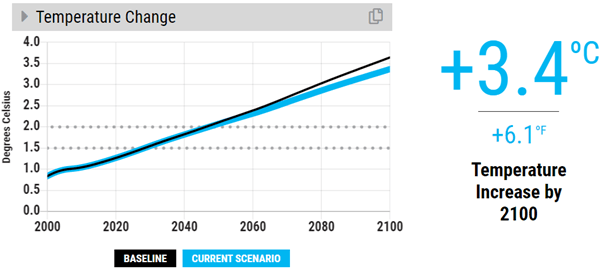
We were actually a bit disappointed with this chart. As we moved the slider on the En-ROADS tool, our left arm fully extended like Iron Man, humming the Star Wars soundtrack, we thought we’d get a bigger reduction in expected temperatures. Perhaps the uncertainty and risks associated with something entirely untested at commercial scale, or with breakthroughs that haven’t even been imagined yet, make the discovery of a new energy source less impactful. Back to reality.
By the way, in case you were wondering, the charts show the cumulative, aggregate effects of applying all of this technology. When we applied each layer of tech, we leave it on and apply the next layer. So, all of the tech discussed so far has given us a 0.2°C reduction in expected warming. Technical note: given the systems-dependent nature of the En-ROADS model (or, in other words, its sophistication beyond our understanding), our cumulative aggregate approach to writing this article does have implications for the results. For the maths geeks out there, think of a multivariate regression with multicollinearity – variables impact each other in the model. To really pick apart each effect in isolation, you’d have to apply the tech layers one-by-one and then layer them in various combinations. This is why we recommend you go to Climate Interactive’s website and have a play around with the tool yourself.
Moving on. What if we apply direct air capture to literally suck carbon out of the air using a giant hoover? No we’re not joking – that really is a thing. It is extremely expensive though and hasn’t been applied at meaningful scale.
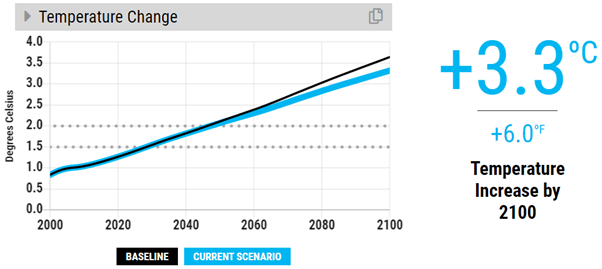
The effect is not bad and in fact this probably overshot our expectations, especially relative to the other effects.
What about other ways of removing carbon from the air? Planting trees isn’t exactly high-tech so we’re not counting that here. But don’t rule out agriculture entirely: the combined effect of enhanced mineralisation (grinding and spreading rocks that help capture carbon over soil), soil carbon sequestration (more cleverer use of agricultural land), and biochar (burying charcoal underground) have quite a significant effect on expected increases in global temperatures…
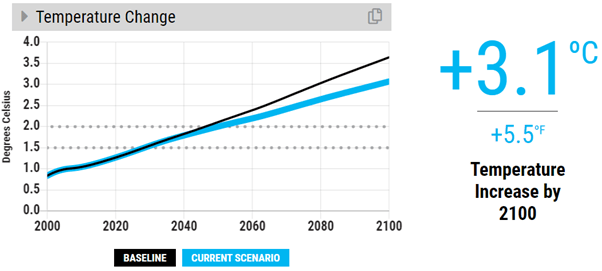
What next? Well, actually, there isn’t much more. There’s a few things we didn’t look at in this article, but that are worth briefly mentioning here
- We mentioned that planting trees wasn’t exactly high tech. And in fact, the effect of planting them only has a minor effect on global temperature increases. You know what would be better? Not cutting them down.
- Something we didn’t talk about was the energy efficiency of buildings, transport, industry. Improving efficiency of existing energy use has a massively positive effect, and while it will of course involve some technology, so does everything, and we wanted to keep our point clear in this article
We conclude with revisiting the point of this article. Our aim was to show that, even with extensive application of technology, and considerable technological breakthroughs, our planet will be in total disarray in less than 50 years. Technology is inspiring, and those who develop it are our heroes. But it is clearly not enough to rely on just technology to meet the climate challenge. Not only does it not have enough of an effect on global temperatures, but it can even remove or create the wrong incentives to actually reduce the burning of fossil fuels. Clearly, more must be done.
 To the pound